
You are using an out of date browser. It may not display this or other websites correctly.
You should upgrade or use an alternative browser.
You should upgrade or use an alternative browser.
piston question
- Thread starter Robgar
- Start date

Throws
Active member
Re: piston question
You're trying to keep the compression at or near stock, the stock ones are dished to keep it low.
TRW L2403:
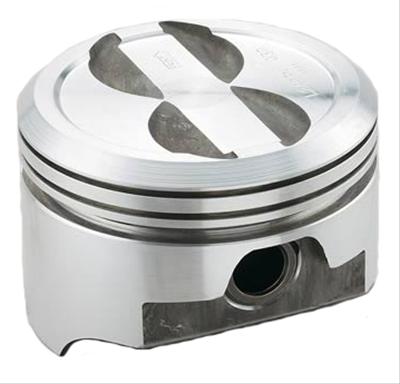
Stock (more or less):

HTH
-P
what changes will have to be made to make them work?
You're trying to keep the compression at or near stock, the stock ones are dished to keep it low.
TRW L2403:
Stock (more or less):
HTH
-P

dgoodhue
BuSTeD 4.3
Re: piston question
The piston usuage with sc and turbo applications are for larger chamber heads (76cc) that are available for SBC. Even in those applications the CR would be closer to 9:1. If you put those pistons our engines the cr would be around 10:1, stock is 8.35:1. To make that work in a stock truck you would need a completely custom tune and lower the boost to 8-9psi for pump gas. If you want to get into ECM tuning with code59, then yes irs possible. if you are not willing to do that its not going to work. I personally would not build around a piston because you can get a good deal on it. There are some good reason to build a higher compression motor, but your not going to get any those benefits with an otherwise all stock motor.
The piston usuage with sc and turbo applications are for larger chamber heads (76cc) that are available for SBC. Even in those applications the CR would be closer to 9:1. If you put those pistons our engines the cr would be around 10:1, stock is 8.35:1. To make that work in a stock truck you would need a completely custom tune and lower the boost to 8-9psi for pump gas. If you want to get into ECM tuning with code59, then yes irs possible. if you are not willing to do that its not going to work. I personally would not build around a piston because you can get a good deal on it. There are some good reason to build a higher compression motor, but your not going to get any those benefits with an otherwise all stock motor.

sytyguy
Moderated User
Re: piston question
A piston itself can be a "turbo/supercharger" piston and be completely wrong for an engine. Our engines have a 8.35:1 compression ratio stock (and with L2441F pistons). So with 14 psi of boost we're around 16.30:1 FCR (final compression ratio at sea level). These pistons (assuming the same 64cc head, 0.017 deck and 0.040 CHGT at sea level) would bump the compression up to, roughly, 10.2:1. That's a nearly 2:1 static CR bump. This is a fact magnified by boost as each psi of boost adds .55:1 CR at 8:1 static, .61:1 CR at 9:1 static, and .68:1 CR at 10:1 static. So, while an engine with an 8.35:1 CR would be seeing an FCR of 19.7:1 at 20 psi of boost, the engine with a 10.2:1 CR would be seeing that same FCR of 19.7:1 at just under 14 psi. Too high of an FCR is what can cause massive mechanical failure (from outright breakage of parts to longterm detonation that kills bearings and other hard parts).
Getting the static CR correct is crucial to you sizing a turbo and enjoying your truck properly. :tup:
A piston itself can be a "turbo/supercharger" piston and be completely wrong for an engine. Our engines have a 8.35:1 compression ratio stock (and with L2441F pistons). So with 14 psi of boost we're around 16.30:1 FCR (final compression ratio at sea level). These pistons (assuming the same 64cc head, 0.017 deck and 0.040 CHGT at sea level) would bump the compression up to, roughly, 10.2:1. That's a nearly 2:1 static CR bump. This is a fact magnified by boost as each psi of boost adds .55:1 CR at 8:1 static, .61:1 CR at 9:1 static, and .68:1 CR at 10:1 static. So, while an engine with an 8.35:1 CR would be seeing an FCR of 19.7:1 at 20 psi of boost, the engine with a 10.2:1 CR would be seeing that same FCR of 19.7:1 at just under 14 psi. Too high of an FCR is what can cause massive mechanical failure (from outright breakage of parts to longterm detonation that kills bearings and other hard parts).
Getting the static CR correct is crucial to you sizing a turbo and enjoying your truck properly. :tup:

Jimmy
Banned
Re: piston question
:stupid:A piston itself can be a "turbo/supercharger" piston and be completely wrong for an engine. Our engines have a 8.35:1 compression ratio stock (and with L2441F pistons). So with 14 psi of boost we're around 16.30:1 FCR (final compression ratio at sea level). These pistons (assuming the same 64cc head, 0.017 deck and 0.040 CHGT at sea level) would bump the compression up to, roughly, 10.2:1. That's a nearly 2:1 static CR bump. This is a fact magnified by boost as each psi of boost adds .55:1 CR at 8:1 static, .61:1 CR at 9:1 static, and .68:1 CR at 10:1 static. So, while an engine with an 8.35:1 CR would be seeing an FCR of 19.7:1 at 20 psi of boost, the engine with a 10.2:1 CR would be seeing that same FCR of 19.7:1 at just under 14 psi. Too high of an FCR is what can cause massive mechanical failure (from outright breakage of parts to longterm detonation that kills bearings and other hard parts).
Getting the static CR correct is crucial to you sizing a turbo and enjoying your truck properly. :tup: